
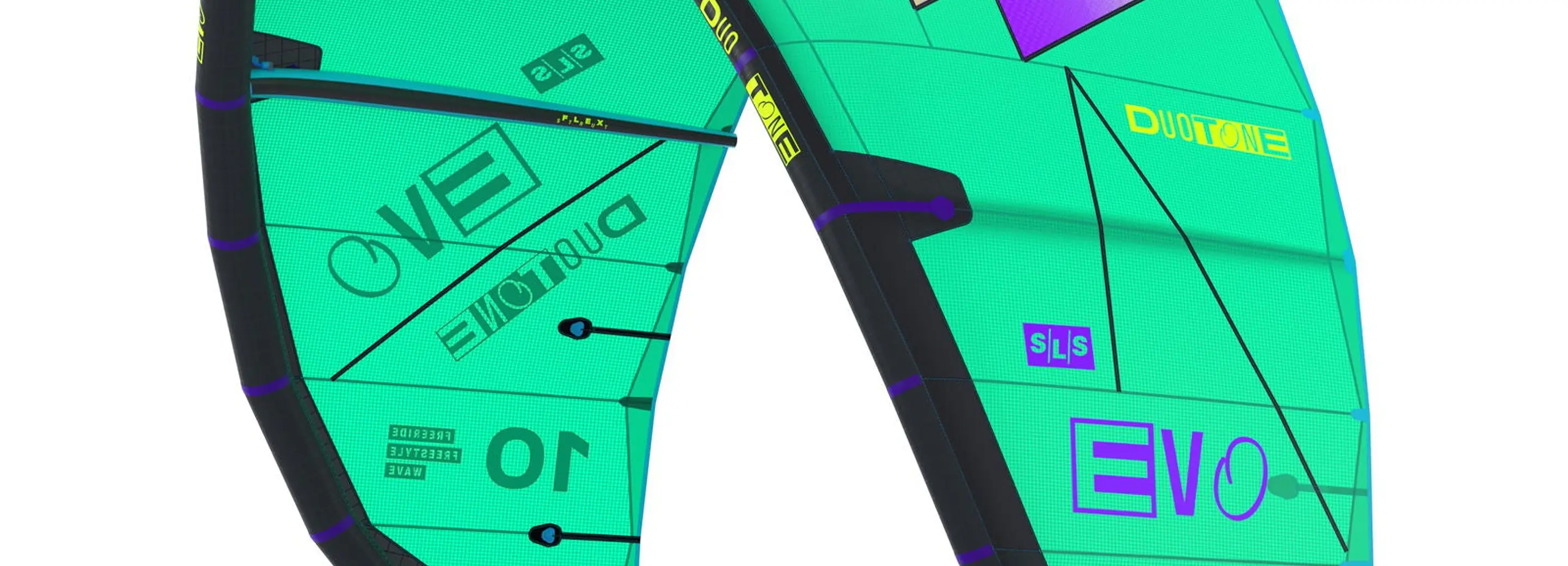
Duotone Evo SLS 2026 Buyer's Guide
Why the Duotone Evo Is the World's Most Popular Kite
The Duotone Evo has been the best-selling all-round kite globally for over five years — and the 2026 SLS version continues that dominance. The reason is simple: no other kite does everything this well. It freerides, it boosts, it foils, it handles gusty conditions, it relaunches effortlessly, and it makes beginners feel safe while giving advanced riders room to push limits.
The SLS (Stiff Lite Skin) construction adds a carbon-reinforced canopy that holds its shape under load, delivering more consistent power, faster turning, and better upwind angle than the standard Evo. It's the sweet spot between the standard construction and the ultra-premium D/LAB.
2026 Evo SLS Specifications
SizeSpan (m)Weight (kg)Wind Range (kts, 80kg)Best For 5m6.82.328–40+Storm sessions, small kite tricks 7m8.12.922–35Strong wind freeride, wave 9m9.23.416–28Core wind range, all-round 10m9.73.714–25Medium wind, most sessions 12m10.64.210–20Light wind, foiling 14m11.54.88–16Ultra light windWho Should Buy the Evo SLS?
Beginners progressing beyond lessons: The Evo's massive depower range and easy relaunch make it the safest high-performance kite for riders still building skills. You'll never outgrow it.
Freeriders who want one quiver: If you ride twin-tip and foil in the same session, the Evo transitions between both seamlessly. No other kite handles this range as naturally.
Riders in gusty conditions: The Evo absorbs gusts better than almost any kite on the market. In thermals, offshore gusts, or variable coastal wind, the Evo keeps you riding comfortably while other kites become demanding.
Evo SLS vs Evo D/LAB
The D/LAB adds full carbon canopy construction — lighter by approximately 300g per size and noticeably stiffer in the canopy. The performance gains are real but subtle: slightly faster turning, marginally better upwind, and a more direct feel. For riders who kite 60+ days per year, the D/LAB premium is justified. For everyone else, SLS is the better value — delivering 90% of D/LAB performance at a significantly lower price.
Evo vs Other All-Round Kites
The Evo's closest competitor is the Cabrinha Switchblade. Both are excellent all-rounders with wide wind ranges. The key differences: the Evo has lighter bar pressure and faster turning; the Switchblade generates more low-end power and has floatier hangtime. For foiling, the Evo has the edge. For light-wind twin-tip, the Switchblade pulls harder. Both are outstanding kites — you can read our detailed Switchblade vs Evo comparison.
What Size Evo Should I Buy?
For your first Evo, choose the size that covers your most common wind range:
- 70kg rider, 15–25 knots: 9m
- 80kg rider, 15–25 knots: 10m
- 90kg rider, 15–25 knots: 11m or 12m
A two-kite quiver of 9m + 12m covers 10–30 knots for most 80kg riders. Check our complete kite size guide for a detailed chart.
What Bar to Use
The Evo works with the Duotone Click Bar in both 4-line and 5-line configurations. We recommend the Click Bar in 22m line length for all-round use. 24m lines add depower range for light wind; 19m lines give faster kite response for wave riding.
FAQ
Q: Is the Evo good for freestyle?
A: Functional but not optimal. For dedicated unhooked freestyle, the Duotone Dice SLS is purpose-built with more direct feedback and stiffer response.
Q: Can I use the 2026 Evo with a 2024 Click Bar?
A: Yes — Duotone maintains cross-season bar compatibility.
Q: How long does an Evo SLS last?
A: With proper care (rinse, dry, store deflated out of UV), 3–5 seasons of regular use. SLS construction holds its shape longer than standard.
Q: Does Surf Store stock all Evo sizes?
A: We stock the full size range from 5m to 14m in SLS. D/LAB available on order. Browse all Duotone kites.