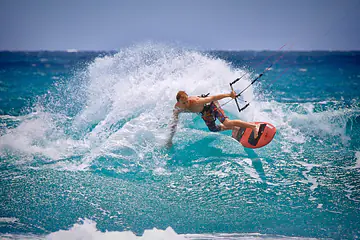
How Long Does It Take to Learn to Kitesurf? — Real Timeline
Most people learn to kitesurf in 10-15 hours of lessons, typically spread over 3-5 days of intensive training. If you're taking lessons once or twice a week, expect 6-8 weeks to reach independent riding level. The timeline depends on your fitness, board sports background, wind conditions, and instructor quality.
The Full Answer
When we talk about learning to kitesurf, we're distinguishing between three skill levels:
- Launch and control: 2-4 hours. You'll understand how to handle the kite safely, launch it without crashing, and feel confident in the power window.
- Body drag and balance: 6-10 hours. You'll drag yourself through the water on the board, develop body awareness, and start linking short rides.
- Independent riding: 10-15 hours. You can consistently ride upwind, perform basic tricks, and handle various wind conditions alone.
Beyond those first 15 hours, progression slows. Mastering advanced tricks, wave riding, or foiling takes months of regular practice. But how long does it take to learn to kitesurf to a safe, fun level? That's solidly in the 10-15 hour window if conditions and instruction align.
Practical Guide
Scenario 1: Intensive holiday learning (3-5 days)
You take 2-3 hour lessons daily in consistent wind. This is the fastest route. By day three or four, you'll be riding short distances. By day five, you're linking turns. The advantage: muscle memory develops without gaps, and you're immersed in the sport.
Scenario 2: Weekend warrior (6-8 weeks)
One or two-hour lesson per weekend. This takes twice as long because you lose muscle memory between sessions. But it fits real life and allows you to absorb theory between lessons.
Scenario 3: Self-taught after lessons (15+ hours)
You take 5-6 hours of professional instruction, then practice alone. This saves money but extends your timeline and raises injury risk. Many beginners plateau without guided feedback on technique.
What accelerates learning? Previous experience with board sports (wakeboarding, windsurfing, snowboarding). Strong swimming ability and fitness. Consistent wind--flat, predictable conditions are easier to learn in. Good instruction from a certified school.
Common Mistakes
Underestimating wind requirements. Many beginners think any breeze works. Reality: you need 12-15 knots minimum to learn efficiently. Too light, and you'll exhaust yourself. Too strong, and you'll panic.
Skipping the full course. Some people book two hours of lessons, try to self-teach, then wonder why they're not progressing. Professional instruction teaches safety systems and technique that take years to discover alone.
Poor equipment choice. Renting is fine early on, but once you're committed, a kite matched to your weight and local wind makes learning smoother. Oversized kites are harder to control; undersized ones waste energy.
Ignoring conditioning. Kitesurfing demands core strength, grip strength, and cardiovascular fitness. Even athletic people feel it. Pre-training helps you absorb lessons instead of just surviving them.
Not respecting progression. Rushing from body drag to tricks costs time. Master the fundamentals--balance, edge control, pop timing--and tricks follow naturally.
Surf Store Recommendation
Once you've completed your initial lessons and are learning to kitesurf independently, you'll need the right setup. At Surf Store, we stock premium kites like the Duotone Dice SLS 2026 and Cabrinha Nitro Apex 2026--both forgiving yet responsive shapes designed for progression. For beginners who've mastered the basics, the Duotone Neo SLS 2026 offers excellent control characteristics and stability in variable wind.
Beyond the kite, quality wetsuits from ION keep you comfortable during longer sessions, which matter when you're building hours. Longer sessions = faster learning. Browse our full kite selection at surf-store.com to find the size and model that matches your conditions and skill level. Our team has real water experience and can guide you toward equipment that fits your learning pace.