How to Choose a Windsurf Fin — Size, Type & Material Guide
Choosing a windsurf fin is straightforward once you know three things: your board size, your skill level, and the conditions you ride most. Fins come in two variables--size (measured in centimetres and area) and type (speed, wave, freeride, freestyle, slalom)--and both directly affect how your board feels underfoot. Get this right, and you'll spend more time ripping; get it wrong, and you'll fight the board all day.
The Full Answer
A windsurf fin works exactly like a plane wing underwater. Its size (usually measured in litres of displacement or cm²) determines how much lift and hold it generates, and its type--the foil profile, rake (angle), and width--determines how it *feels* turning, accelerating, and holding edge.
Start with board size. Most windsurfing boards come with a recommended fin range (often printed on the board itself or in the manual). A freewave board around 75 litres, for example, might suit a 35-42cm fin. Smaller boards and lighter riders need smaller fins; larger boards and heavier riders go bigger. If your fin is too small, the board becomes twitchy and hard to control; too large, and it becomes sluggish and forces you to use excessive power.
Fin type matters as much as size. A speed fin is narrow, has a sharp rake, and locks you into tight turns--ideal for bump-and-jump or racing. A wave fin is shorter with more width, releasing quickly for radical manoeuvres. A freeride fin splits the difference, giving you predictable hold and progressive turning. Most recreational riders use freeride fins because they're forgiving and fun across a wide wind range.
Finally, match your style and skill. Beginners benefit from slightly larger, more forgiving fins that don't require perfect technique. Advanced riders often prefer smaller, more responsive fins that reward precise footwork and weight transfer. If you're just starting out on a big, stable board, don't assume the biggest fin available is your friend--you might be better served by a mid-range option that lets you develop a feel for the board before you demand responsiveness.
How to Choose Your Fin in 5 Steps
- Check your board's fin box and manual -- Most boards come with a recommended fin size range. This is your starting point, not your limit. Honour it.
- Measure or weigh yourself and assess your board volume -- Heavier riders and larger boards need larger fins. A general rule: aim for a fin area of roughly 35-45% of your board's litres. Ask yourself: do I need hold and drive, or release and playfulness?
- Identify your primary riding style -- Freewave? Freestyle? Bump and jump? Slalom racing? Each discipline has a preferred fin type. Freeride fins work for most conditions; if you're mixing styles, start there.
- Test before you buy -- Borrow a mate's fin or rent a few options. Wind conditions vary wildly across Europe; what works in the Baltic may feel wrong on the Mediterranean. Ride the same board with two different fins and you'll instantly understand.
- Build a small quiver -- Buy a mid-range size first, then add one size up and down. You'll then be able to sail comfortably in 12-25 knots without constantly swapping. Two or three fins of the same type across sizes is more useful than one massive fin.
- Don't confuse price with fit -- An expensive carbon fin for slalom racing is wasted on a beginner's freewave board. Start with a mid-priced, general-purpose option and upgrade only when you've outgrown it.
Common Mistakes When Choosing a Windsurf Fin
New riders often assume a huge fin will make the board easier to control. In reality, an oversized fin locks you in place, forces unnecessary effort, and stalls the board in light wind. Pick a size that lets the board flow and turns easily--you'll progress faster.
Windsurf boards use different fin systems: tuttle (most common), US box, and ultra-tuttle. Buying a fin that doesn't fit your box wastes money and time. Check your board manual first.
If you only sail in 8-knot light wind, a racing slalom fin will be miserable. Choose a fin that works across your typical wind range--usually 12-25 knots for most European spots. A freeride fin is your best bet for versatility.
A 42cm wave fin and a 42cm speed fin perform very differently because their foil profiles and rake are opposite. Don't assume the same centimetre measurement means the same ride. Read the product details.
What We Stock at Surf Store
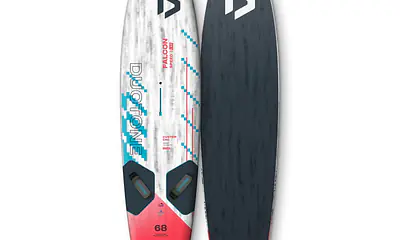
At Surf Store, we carry a curated range of windsurf boards from brands like Duotone, JP Australia, Tabou, and Fanatic. Every board in our collection comes with detailed fin recommendations and specifications--and crucially, our team has ridden each one, so we can tell you exactly which fin size and type works best for your weight, skill, and local conditions.
If you're setting up a new board or upgrading your quiver, we recommend starting with a freeride-type fin in the mid-range of your board's recommended size. This gives you the broadest wind window, the most forgiving response, and the confidence to push your riding without fighting the equipment. Brands like Duotone and JP Australia produce excellent general-purpose fins that won't break the bank and will serve you well as you develop your style.
Not sure which fin is right for you? Drop us a line with your board size, weight, and typical wind conditions, and we'll recommend a specific product. We've been doing this since 2003, and we ride everything we sell.
Ready to Find Your Perfect Fin?
Expert advice on fin selection, authorised stock from Duotone, JP, Tabou, and Fanatic. Ships across Europe within 24h.