
How to Jibe in Windsurfing — Step-by-Step Technique Guide
A jibe in windsurfing is a downwind turn where you pivot the board's tail (rear end) through the wind direction, keeping the sail powered the entire time. It's the opposite of a tack and the fastest way to change direction--essential for freewave riding, slalom, and freestyle. Done well, you'll stay locked in and maintain momentum; done poorly, you'll lose the board or get catapulted. Here's how to nail it.
The Full Answer
Unlike a tack (where you turn into the wind and the sail goes limp), a jibe keeps you sailing downwind. You're essentially swapping which foot is forward and reversing your grip on the boom--all while the sail stays filled with wind. This continuous power is what makes jibes fast and why they're the preferred turn for reaching and running angles.
The key difference between a jibe and a tack technique lies in board rotation and sail transition. In a tack, the nose turns through the wind; in a jibe, the tail sweeps through. Your upper body and sail work together to initiate and complete the turn. Beginners often confuse the two because both involve changing direction, but the jibe windsurfing tack technique is actually independent of traditional tacking--it's its own discipline that rewards rhythm and aggression.
Modern freewave and freestyle sailors live in jibes. You'll see them carving down the beach, throwing in three, four, even five jibes in a row, each one tighter and smoother than the last. The technique scales from "beginner jibe" (a wide, safe turn) to "advanced jibe" (tight carving manoeuvre with foot flicks and minimal sail play). Mastering it opens up a whole new dimension of windsurfing.
Practical Guide
- Approach downwind -- Set up on a broad reach or run, with the sail powered and your weight centred. Build a little pressure in your front foot to keep the board flat. You need momentum to complete the jibe.
- Initiate the carve -- Weight your back foot and push the tail down and away from your body. The board will start to pivot downwind. Keep your head up and look where you're going, not at your feet.
- Swing the sail -- As the board rotates, use your front arm (boom hand) to guide the boom overhead and across to the new side. Don't throw it; guide it smoothly. The mast should stay relatively centred over the board.
- Swap your feet -- Quickly bring your back foot forward (it becomes your new front foot) and step onto the opposite rail. This is called the foot change. Timing is critical--too early and the sail catches; too late and you lose balance.
- Grab the boom -- Your back hand (now approaching from the opposite side) grabs the boom as it passes overhead. Settle into a new power stance, weight centred, sail sheeted in. You should exit the jibe already sailing on your new heading.
- Practice on flat water -- Learn jibes in light wind (10-15 kts) and flat conditions before attempting them in waves. Flat water gives you control and time to think; rough water will punish sloppy technique.
Common Mistakes
Aggressive sailors often yank the boom across too fast, causing the sail to lose tension or the mast to move away from centre. Keep the swing smooth and controlled; the sail should stay powered and the mast should track over the board. Speed comes from carving, not sail throwing.
If you step your back foot forward before the board has rotated past downwind, the sail will collapse or the boom will whack you. Wait until the board's nose is pointing roughly where you came from before you change feet. This timing becomes automatic with practice.
Moving your weight too far aft will cause the tail to sink and the jibe to stall. Keep your weight relatively centred--slightly forward of centre during initiation, then balanced as you carve. You're pivoting the board, not pushing it sideways.
Attempting a jibe in 25+ kts or at an upwind angle will usually end in a wipeout. Jibes are downwind manoeuvres; if the wind is pushing you upwind, do a tack instead. Choose lighter winds (12-18 kts) until you're confident.
Surf Store Recommendation
Jibes are technique-driven, but your board and sail choice absolutely matter. Lighter, more responsive boards make jibes easier because they pivot faster and need less force. Freewave and freestyle boards are specifically designed for jibing--they have reduced volume, shorter tails, and better pivot zones than slalom racers.
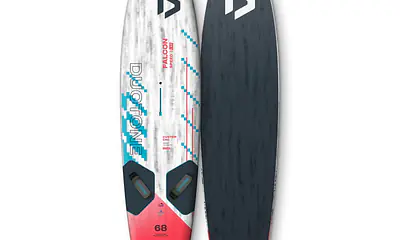
If you're learning to jibe, pick a freewave sail in the 4.5-5.5 m range and a directional board with good lateral release. Duotone's freewave range--such as the Duotone Ultra FreeWave 2025 paired with a sail like the Duotone F_Pace or Duotone E_Pace 2025--offers the predictability and forgiveness you need to develop smooth technique. As you progress, lighter D/LAB boards like the Duotone Falcon_Speed D/LAB reward aggressive carving and tight jibes.
Responsive, forgiving, and designed for constant direction changes. The Ultra FreeWave makes learning and perfecting jibes enjoyable--it turns on a knife edge but won't punish timing errors.
A freewave sail that transitions perfectly from tacks to jibes. Light hands, predictable handling, and smooth through the wind window. Pair it with any freewave board and you'll develop bulletproof technique.
Ready to Master the Jibe?
Expert advice, hands-on guidance, and a full range of freewave boards and sails in stock. We've been shipping across Europe since 2003.