Kite Foil vs Kiteboard 2026 — Which Should You Start With?
Quick Verdict
If you're just starting kitesports, a traditional kiteboard is the safer choice--lower cost, more forgiving, and works in a wider range of wind and locations. However, if you have shallow water or small spaces nearby and a bigger budget, a kite foil is the future--smoother ride, less gear, and the fastest learning curve for progression riders. Most riders should own both eventually, but your first purchase depends on your local conditions and wallet.
Side-by-Side Comparison
Feature Kite Foil Kiteboard Entry Cost €1,800-2,500 €800-1,200 Learning Curve 4-6 weeks (smoother) 3-5 weeks (more crashes) Wind Range 8-20 kts (light wind magic) 10-25 kts (versatile) Space Required ✓ Minimal (shallow water) -- Larger (needs run-up space) Durability -- Foil can break; costlier repairs ✓ Tough; simple fixes Progression Speed ✓ Fast (smooth feel = quick tricks) -- Slower (impact feedback) Freestyle/Tricks Limited (no wave riding) ✓ Wakestyle, jumps, tricks Best For Light-wind zones, progression riders Beginners, all-round fun, tricksKite Foil -- Full Review
A kite foil is the newest evolution in kitesports. Instead of a traditional board with fins, you ride a hydrofoil--a submerged wing that lifts you above the water once you hit speed. The result: almost zero friction, silent gliding, and the ability to ride in winds as light as 8-10 knots.
Why it works: Once airborne, the foil eliminates water resistance, meaning you need less power from the kite. You'll carve smoother arcs, progress tricks faster, and spend less time falling (which many riders find less demoralising than constant wipeouts). The ride feels almost ethereal compared to a kiteboard.
The catch: Foils are expensive (€1,800-2,500 complete), fragile--a crack in the mast or wing ends your session and your wallet--and require perfectly flat water. If your spot has chop or currents, foiling is harder. You also need 2-3 weeks just to get comfortable finding that sweet spot where the foil lifts.
Best for: Light-wind enthusiasts, riders with shallow bays or lagoons, and progressing athletes who value smooth, controlled progression over raw fun and tricks.
Traditional Kiteboard -- Full Review
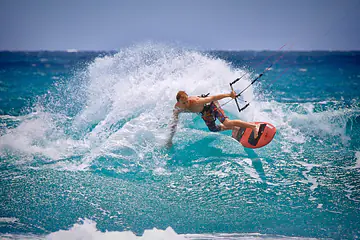
A kiteboard is a directional board (3-4 feet long) with fins underneath, ridden just like a wakeboard. You generate speed, make the board plane (float) on the water surface, and use that momentum to edge, jump, and carve. It's the classic setup that's dominated kitesports for two decades.
Why it works: Kiteboards are forgiving. Crashes don't destroy them; they're cheap to repair. They work in a wide wind range (10-25 kts), on chop and flat water, and they're the platform for tricks, jumps, and freestyle. Learning feels more natural if you've wakeboarded or surfed. Plus, you can progress through tricks immediately--no expensive specialist gear.
The catch: They demand more space (bigger run-up), heavier wind (10+ kts minimum), and more physical energy to stay upright. You'll fall more often in your first weeks, and impact hits hard. You also need to understand board control, weight distribution, and kite management simultaneously--it's multitasking.
Best for: Beginners on a budget, trick enthusiasts, riders in consistent-wind spots, and anyone who wants versatility (jumps, waves, style, and speed).
Who Should Choose Each?
Ideal Rider Profile
Light-wind zone (under 12 kts average), access to flat water or a shallow lagoon, €2,000+ budget, patient learner who values progression smoothness over immediate tricks, and wants to minimise the number of wipeouts.
Ideal Rider Profile
Consistent-wind spot (10-25 kts), budget under €1,200, interest in tricks and freestyle, experience with board sports (wakeboard, snowboard), and tolerance for a steeper initial learning curve with more crashes.
Our Recommendation
If you're new to kitesports and live in Europe with average winds of 12+ knots, start with a kiteboard. A board like a Fanatic board paired with a Duotone Evo SLS 2026 or Cabrinha Nitro Apex 2026 gives you the best bang for €1,200-1,500. You'll learn the fundamentals, progress to tricks, and have a board that works in most conditions. Kiteboards are the proven path; millions have learnt on them, and for good reason.
However, if your local spot has light, patchy winds (8-12 kts) or shallow, protected bays, or if you want the smoothest possible learning experience and can afford it, a kite foil is worth the investment. You'll progress faster, stay drier, and unlock a whole new dimension of the sport. Just ensure you have flat water access and budget €1,800+ for a quality setup. Either way, we stock complete kite packages with expert setup--contact us to match your conditions and goals.
Ready to Gear Up?
Expert advice, authorised stock, ships across Europe within 24h. We'll help you choose the right setup for your local conditions and skill level.