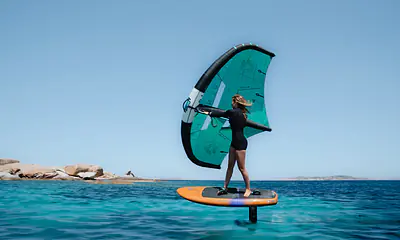

Wing Foiling Gybes & Tacks — Turning Technique Guide
A gybe is a downwind turn where you pivot the board beneath you, swap your wing to the opposite side, and continue in a new direction without crossing the wind. A tack is an upwind turn where you head into the wind, cross through the neutral zone, and flip your wing to the new side. Both moves are fundamental to wing foiling technique--mastering them means you can navigate tight spaces, change direction smoothly, and keep your foil flying without falling off.
The Full Answer
Wing foiling gybe and tack turns are very different from traditional windsurfing or kitesurfing, because your foil board sits so high on the water that weight distribution and wing angle are everything. Unlike a board that floats, a foil needs constant forward momentum and wing pressure to stay airborne--lose either, and you sink. That's why transitions feel less forgiving at first, but once you understand the sequence, they're smoother than they look.
The gybe works because you're turning away from the wind. You maintain forward speed by keeping the wing loaded on your current side, then pivot your hips and feet to rotate the board. As the board swings downwind, you release the wing's trailing edge (the back hand), rotate the wing in front of you, and catch it on the new side. The whole motion takes about two seconds. Your wing never fully stalls because you're moving fast enough to keep flying--you're just reorienting it.
The tack is harder because you're heading directly into the wind. The wing loses power as you approach the neutral zone, so your foil wants to drop. To keep altitude, you edge your board hard (rail pressure) and use a rapid wing flip to shift pressure to the new side before momentum fades. Many riders fail their first few tacks because they flip the wing too slowly or don't edge the board early enough--the foil sinks and they have to foot-swim back on.
The mental shift from both is this: in a gybe, speed is your friend; in a tack, aggressive footwork and timing are everything. Practice gybes first--they're confidence builders and fun--then graduate to tacks once you're comfortable with the board rotation.
Practical Guide: Step-by-Step Gybe & Tack
GYBE (Downwind Turn)
- 1. Set up with speed -- Start on a broad reach or downwind angle so you have momentum. Keep your wing loaded and your weight forward on the board. Mentally pick your exit direction before you start.
- 2. Initiate the pivot -- Shift your weight to your back foot (the one closest to the tail). This pressure lifts the front of the board and rotates the nose downwind. Keep the wing angled and powered--don't collapse it.
- 3. Release and flip the wing -- As the board swings past downwind, open your back hand (release the trailing edge) and rotate the wing in front of your body. Aim to catch it on the opposite side before the board has fully turned. This is the key: flip early.
- 4. Absorb and accelerate -- Catch the wing on the new side, shift your weight forward again, and lean into your new edge. You should feel the board re-accelerate almost immediately as the wing pressurises on the new tack.
TACK (Upwind Turn)
- 1. Build speed on a close reach -- Approach the tack on a tight upwind angle with good velocity. Avoid coming in too slow, or your foil will drop during the neutral zone.
- 2. Weight back and rail hard -- Push your weight onto your back foot and press hard on your heel edge (or toe edge, depending on which way you're turning). This edge pressure is what keeps the foil flying as wind pressure fades.
- 3. Flip the wing fast -- As you rotate into the wind and the wing goes neutral, flip it quickly to the new side. Don't hesitate or the foil sinks. Speed of the flip is everything--think of it as a quick flick, not a slow rotation.
- 4. Catch power and drive forward -- The moment the wing hits the new side, compress your legs slightly and drive forward on the board to rebuild momentum. Your front foot should roll forward and your weight should move toward the board's centre.
- 5. Exit on a broad reach -- Don't try to come out too tight upwind. Aim for a close reach on the new side first, build speed, and then tighten up. Trying to be too high after the tack is a common reason people sink.
Common Mistakes
On a tack especially, a slow wing rotation means the foil loses power mid-turn and sinks. Wing flips need to be snappy--think of it as a flick of your wrists, not a smooth arc.
If you relax your heel or toe edge during the neutral zone of a tack, your foil immediately wants to drop. Keep rail pressure on until the wing is fully loaded on the new side.
Wing foil tacks need speed and momentum to work. Creeping in on a dying angle means your foil has less lift to work with when wind pressure fades. Build speed first, then tack.
After completing the tack, many riders immediately try to point high. Instead, exit on a broad reach, rebuild speed, and then gradually tighten. Rushing the exit kills momentum and causes sink.
Surf Store Recommendation
To practise turns smoothly, you need a wing foil setup that's forgiving and responsive. We stock a full range of Gaastra foil systems and Duotone wing foil boards that are built for exactly this kind of progression. If you're learning gybes and tacks, a stable board with good glide and a flexible foil will give you the confidence to commit to each turn.
Forgiving, durable, and smooth-turning. The aluminium fuselage offers consistent glide through transitions, and the 72cm wing is perfect for learning gybes and tacks without getting punished by sensitivity. Great all-rounder for progression.
A responsive, well-balanced wing foil board that rewards clean technique. The Sky Free turns predictably and accelerates smoothly--exactly what you need when you're drilling gybes and tacks. Excellent feedback on board pressure and edge control.
Pair either with a versatile wing like the Gaastra Wing 2026 Pure--smooth in all conditions and forgiving during transitions--and you'll have everything you need to nail your turns.
Ready to Master Your Turns?
Expert advice, proven gear, ships across Europe within 24 hours. Let us help you dial in the perfect wing foil setup for gybe and tack practice.