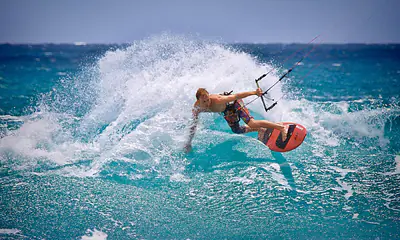

How to Body Drag Upwind — Essential Kitesurfing Rescue Skill
Body dragging upwind is one of the most important safety skills every kitesurf rider must master. To do it, you position the kite directly overhead (12 o'clock), lie back in the water, lean your weight backward, and let the kite's power pull you against the wind. It's not about fighting--it's about using the kite's lift as an anchor and your body weight as the load.
The Full Answer
Body dragging upwind--often called an upwind rescue or upwind body drag--is essential when you lose your board or get separated from it. Unlike body dragging downwind (which happens naturally), dragging upwind requires deliberate kite control and body mechanics to fight the wind and current.
The core principle is simple: the kite generates lift, your body provides weight and drag, and together they move you against the wind. Your position in the water matters enormously. You're not swimming; you're being towed backward by the kite's power. If your kite is too high or too low, you'll spin out or sink. If it's overhead at 12 o'clock, you'll move steadily upwind.
Why learn this? Losing your board happens to everyone--snapped lines, a wipeout in strong wind, falling off during a transition. Without the ability to body drag back to your board or the beach, you're at risk. Strong riders can generate surprising speed upwind; weaker riders move slowly but still progress. Either way, you're safe, you're moving, and you're in control.
The technique also teaches you kite handling and body awareness in challenging conditions--skills that make you a safer, more confident water user overall.
Practical Guide
- Position your kite overhead -- Bring the kite to 12 o'clock (zenith), directly above you. This maximises lift and minimises sideways drift. Use small bar inputs to hold it dead centre.
- Lean back hard -- Your body should be nearly horizontal, with your head and shoulders back in the water. The more you lean, the more drag you create, and the more the kite must work to pull you. Don't sit upright or tread water.
- Keep your legs together -- Straight legs create less drag noise and help you stay streamlined. Cycling or treading water slows you down and wastes energy.
- Adjust bar pressure slightly forward -- A tiny bit of forward input keeps the kite responsive but doesn't collapse it. You're not diving the kite; you're keeping it flying cleanly overhead.
- Move in straight lines -- Aim for a fixed landmark upwind (a building, cliff, or breakwater). Avoid zigzagging; it wastes distance and energy.
- Stay calm and trust the process -- Even in light wind, a well-positioned kite overhead will generate lift. Don't panic-flap the bar; stay smooth and patient. Speed builds gradually.
Common Mistakes
Many riders hold the kite at 10 o'clock or 2 o'clock, which creates sideways drift and wastes energy fighting wind shear. The kite must be at 12 o'clock--dead overhead--to maximise power and minimise lateral movement.
Sitting or swimming upward creates drag in the wrong direction and exhausts you. Lean back, let your body become a water anchor, and let the kite do the work. Horizontal position = maximum efficiency.
Jerking the bar or making large movements will collapse the kite or send it diving. Small, smooth inputs keep the kite flying cleanly overhead. Think trim, not control.
If you feel the kite slip, the instinct is to let go. Stay with it. Small bar movements will recover the kite. Releasing the bar loses all power and leaves you stranded.
Surf Store Recommendation
Body dragging upwind is a technique question, not a gear question--every kite from a modern mainstream brand (Duotone, Cabrinha, NeilPryde, ION) will allow you to do it if the wind is strong enough. What matters is kite size relative to wind strength. Too small a kite in light wind won't generate lift; too large a kite in strong wind will be uncontrollable.
If you're buying your first kite or upgrading for better upwind control, look for a forgiving model with predictable handling overhead. The Duotone Evo SLS (available in 2025 and 2026 versions) is renowned for smooth, responsive bar feel and clean overhead flying. If you prefer a more playful ride, the Cabrinha Nitro Apex 2026 offers similar control with a bit more drive. Both are trusted by rescue teams and skill coaches across Europe.
Beyond the kite, a good quality bar and reliable lines are essential. A bar with smooth steering and a solid kite connection lets you hold 12 o'clock without fighting constant micro-adjustments. Talk to our team if you're unsure about your current setup--a simple adjustment or upgrade can make upwind dragging dramatically easier.
Ready to Master Upwind Rescue?
Proper technique and well-maintained gear are your safety foundation. Chat with our experts today.