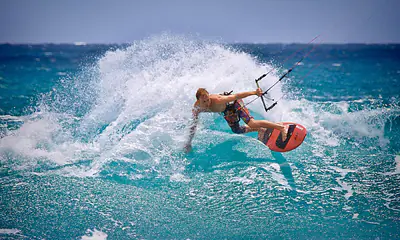

How to Choose a Kite Bar — Line Length, Safety, Compatibility
The best kite bar for you depends on three core factors: boom length (matched to your kite sizes), depower range (typically 25-30% of total throw), and safety features that suit your experience level. Most riders stick with one bar across a quiver of kites--so compatibility across your full range is more important than chasing marginal performance gains.
The Full Answer
A kite bar isn't just a handle--it's your primary control interface. It connects you to your kite through four lines, and your hand position on that bar determines how much depower you have (how far you push it away), how much power you're using (how far you pull it toward you), and ultimately how safe and confident you feel in the water.
The most critical measurement is boom length. Kite bars come in fixed sizes--typically 13", 15", 17", or 19" wide. Longer booms pair with larger kites (14-17m); shorter booms work with smaller freestyle kites (9-12m). A bar that's too short for your biggest kite feels cramped and stiff. A bar that's too long for your smallest kite becomes sluggish and hard to flip or rotate. Most riders who own 2-3 kite sizes choose a mid-range bar (15" or 17") that sits comfortably across their quiver.
Depower range is how much line you can release before the kite loses all power. A bar with a 30% depower throw means you can push it fully away and still have tension on the lines--critical for safety in a gust. Entry-level bars often have 20-25% depower; premium bars offer 28-32%. For beginners, maximum depower is a genuine safety feature; for advanced riders, it's often less critical because you're already skilled at reading wind and making micro-adjustments.
Safety systems vary by brand and price. Look for: a clean, reliable quick-release (QR) that's easy to find and use with gloves; a chickenloop that won't accidentally unhook; smooth line routing that won't twist or jam; and a solid bar structure with no cracks or loose fittings. Cheap bars may save you €50, but a failed QR or cracked boom during a session costs you a kite or worse.
Practical Guide
- List your kite sizes -- Write down every kite you own or plan to own. A 15m freestyle kite and a 17m wave kite need different bars. A bar that works for 12-15m is very different from one for 14-17m. Use this list to find the sweet spot.
- Check boom length compatibility -- Cross-reference your kite brand's recommended bar widths. Duotone Evo SLS kites, for example, typically pair with a 15" or 17" bar. Most brands publish this in their specs.
- Test depower in your conditions -- Visit your local spot and ask to try a friend's bar in similar wind. Push it fully away. Can you hold the kite steady? Does it still have clean power when pulled halfway? This tells you if the depower range suits your wind window.
- Handle the quick-release yourself -- Don't just look at it. Grab it with cold, wet hands (or gloved hands). Can you find it instantly? Can you pull it without hesitation? A QR you can't find in a panic is worthless.
- Match bar type to your riding -- Freeride bars prioritise comfort and depower. Freestyle bars are lightweight and responsive. Wave bars are compact and durable. Choose the category that fits your primary discipline.
- Buy from an authorised retailer -- Fake or grey-market bars have inconsistent safety standards and no warranty. We stock bars from Duotone, Cabrinha, and other trusted brands, and we'll help you match it to your setup.
Common Mistakes
Many riders choose a 19" bar because it 'feels premium' or because their 17m kite looks good on it. Then they buy a 12m freestyle kite and realise the bar is impossibly wide and slow to respond. Buy for your average kite size, not your largest.
A bar with only 20% depower will leave you under-powered in sudden gusts. You can't push it any further away. Beginners and intermediate riders especially need at least 25-28% depower for safety margin.
A €200 bar sounds like a bargain until the QR corrodes, the lines tangle, or the boom cracks. Premium bars from Duotone or Cabrinha cost more because they're engineered for consistency and durability across hundreds of sessions.
A spec sheet can't tell you if a bar feels right in your hands. Always borrow a friend's bar or rent one for a session before buying. How you choose a kite bar is personal--what works for a waverider might feel bulky for a freestyle rider.
Surf Store Recommendation
We stock kite bars from Duotone and Cabrinha--the two brands that dominate European kitesurfing for good reason. Both offer bars across every discipline (freeride, freestyle, wave) and price point, and both are trusted by thousands of riders in our community since 2003.
If you're just starting out or stepping up your setup, visit us with your kite model and we'll match you to a bar that works across your current and planned quiver. We'll also walk you through the safety features, show you the QR, and answer any questions before you buy. Free EU shipping from €99 and a 30-day return window mean zero risk.
Ready to Gear Up?
Expert advice, authorised stock, ships across Europe within 24h.