How to Waterstart Windsurfing — Beginner Step-by-Step Guide
A waterstart is when you pop yourself and the board up from deep water using the sail's power and leverage, rather than starting from shallow water or the beach. It's the gateway to progression: once you master it, you can launch from any depth and ride in any spot. If you want to stop being tethered to the shallows and truly explore windsurfing, the waterstart is non-negotiable.
The Full Answer
The waterstart works by combining three forces: your body weight pulling down on the boom, the sail's power pulling you forward, and the board's flotation pushing up beneath you. You start horizontal in the water, facing upwind, with the board to your side and the sail powered on your side. As you pull the boom down and toward your chest, the sail generates lift. Simultaneously, you lean back and allow your weight to compress the water, which forces the board to pop up. The trick is timing--power must arrive at the exact moment your body commits to rising.
Most beginners struggle because they either don't commit their weight fully (they stay too upright and sink), or they pull the sail in too slowly (no power, no pop). The best riders waterstart with their head relaxed back, eyes on the horizon, and the boom firmly locked against their chest. The board rises almost automatically when all three elements align.
Wind matters. In 10-12 knots, a waterstart is possible but demands precision and effort. In 16-20 knots, it becomes almost effortless--the sail does the work for you. This is why many windsurfers say they truly learned to waterstart only when conditions got windier. Don't be discouraged if light wind feels impossible; it's not a reflection of your skill.
The waterstart also builds core strength, proprioception (body awareness in water), and confidence. Once locked in, you'll find yourself doing it instinctively, even in choppy water or on marginal wind days. It transforms your entire windsurfing experience.
Practical Guide
- Position yourself upwind -- Lie on your back in the water with the board 2-3 feet to your side (closer as you improve). Keep the sail powered and angled so the clew is below your body. Your head should be relaxed, looking downwind at the horizon.
- Grip the boom firmly -- Grab the boom with both hands about hip-width apart, in the lower-middle section. Don't grip too far back; you need leverage. Your arms should be straight or slightly bent, ready to pull.
- Pull the boom down and toward your chest -- In one explosive motion, haul the boom down as if you're doing a rowing motion. This creates maximum sail power and lift. Keep your elbows high and drive the boom toward your ribs.
- Lean back and commit your weight -- As you pull, lean your head and shoulders back into the water. Your weight pushing down into the sea is what forces the board up. Hesitation kills the waterstart; go for it fully or sink.
- Stand up as the board rises -- The moment the board lifts beneath you, straighten your legs and pop upright. Let the sail's power carry you. Don't stand too early (before the board is up) or too late (you'll fall back in).
- Move your feet to the harness lines -- Once vertical, step one foot back toward the harness and lock in. The other foot moves forward. You're now riding; let the board's momentum carry you across the water.
Common Mistakes
Many beginners keep their shoulders too high and their body too vertical, as if trying to stay dry. This kills the compression force needed to pop the board up. You must lean back and accept getting wet; the waterstart requires a full commitment of your body weight into the water.
If you tug gently, the sail won't generate enough power to lift you. The pull must be explosive and firm--think "rowing" rather than "testing the water." A slow, weak pull guarantees a failed attempt and a swim.
In 8-12 knots, the sail alone won't do the work; your technique and timing must be perfect. Many beginners blame light wind and quit, when really they just need to pull harder and lean back more. Save light-wind waterstarts for when you're experienced.
If the board is 5+ feet from your body, you'll exhaust yourself reaching it and lose leverage on the boom. Keep it 2-3 feet away, close enough to grab and control but far enough to pop without hitting your legs as it rises.
Gear for Learning to Waterstart
To succeed at waterstarts, you need a stable, forgiving board and a responsive sail. A larger board (around 90-100 litres if you're an adult) provides more flotation and makes the pop easier. A sail with good low-end power (12-17 knots) helps you practise in variable conditions without requiring perfect technique.
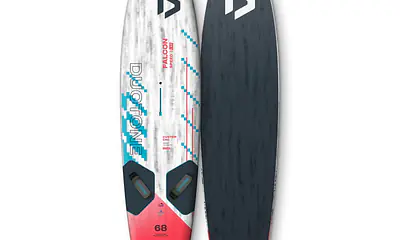
We recommend starting with a freewave or wave board in the 85-100-litre range--boards like the Duotone Ultra FreeWave offer excellent stability and response. Pair it with a mid-range sail such as the Duotone E_Pace or Duotone Duke, which have forgiving power delivery and help you focus on technique rather than fighting the gear.
The Ultra FreeWave is forgiving enough for waterstart practice but responsive enough to reward good technique. Its stability gives you confidence to commit fully to the pop, and the flotation makes every attempt count.
The E_Pace is our go-to sail for progression. It delivers power smoothly across a wide wind range, so you can practise waterstarts from marginal winds up to 20+ knots without fighting the sail. Predictable handling lets you focus on your pop timing.
Ready to Master the Waterstart?
Our team has taught hundreds of windsurfers to pop up from the water. We stock boards and sails designed for smooth progression, and we're here to help you dial in your setup.