What Is Big Air Kitesurfing? — Jumping & Tricks Explained
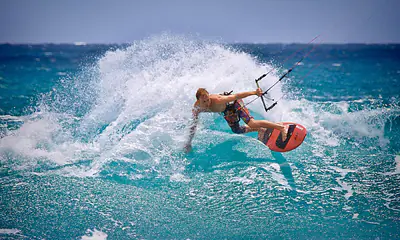
Big air kitesurfing is the art of using your kite's power to launch yourself high above the water, perform aerial tricks, and land smoothly. It's the bridge between cruising and full freestyle--where you learn to control your body in the air and build the confidence for more complex manoeuvres.
The Full Answer
Big air in kitesurfing is fundamentally about generating enough kite power to lift off the water with speed and momentum, then manipulating your board and body position mid-flight before coming back down safely. Unlike flat water tricks, big air requires genuine height--typically 1-3 metres or more--which demands clean wind, proper kite control, and board speed. The kite does the heavy lifting; your skill is managing that energy and steering yourself through space.
The discipline sits at the heart of freestyle kitesurfing. You start with simple jumps--riding fast, edging hard, and letting the kite pull you skyward--then progress to grabs (holding your board mid-air), rotations (spinning yourself or the board), and combinations. Every big air trick begins the same way: build speed, edge your board hard into the wind, pop off a wave or chop, time your kite movement perfectly, and absorb the landing. It's part physics, part feel, and entirely addictive once you catch your first clean meter of height.
What makes big air different from other kitesurfing styles is that it rewards explosive power and timing over smooth, flowing movements. Racers and wave riders prioritise efficiency; big air athletes prioritise pop. You need wind--ideally 12-20 knots--a relatively flat spot to build speed, and a kite that responds instantly to your input. Most big air athletes ride smaller kites (12-15m) in strong wind rather than massive ones in light air, because responsiveness and control matter more than raw power.
Practical Guide
- Start with flat water or small chop -- Find a spot with minimal swell so you can focus on kite control, speed, and timing without fighting waves. Lakes, bays, and shallow lagoons are ideal for learning.
- Build speed in a straight line -- Ride hard on one edge, keeping your weight forward and your kite steady in the 12 o'clock position. Speed is everything; without it, your kite won't have enough load to lift you.
- Edge hard and pop your board -- As you reach peak speed, press your back foot down, pop up through your legs, and drive your kite quickly to either 11 o'clock or 1 o'clock. The kite movement is aggressive and fast, not smooth.
- Keep your kite moving -- Once airborne, maintain kite pressure by keeping it powered in the direction of your jump. Don't let it go slack or dip below the horizon, or you'll drop hard.
- Spot your landing and absorb impact -- Look where you're coming down, bring your kite back to 12 o'clock as you descend, and flex your knees to cushion the landing. Stiff legs = injuries.
- Master grabs and small rotations before combinations -- Learn to grab your heel or toe edge mid-air, then add 180° spins. Only chain tricks together once each one is solid in isolation.
Common Mistakes
Many riders move the kite slowly or let it drift instead of snapping it aggressively. Without tension, the kite can't generate lift, and you'll pop weak jumps or hang in the air with no control.
Big air demands speed. If you're cruising gently, the kite won't have enough power to pull you skyward. Commit to hard edging and build genuine momentum before you attempt any jump.
A static kite loses power mid-flight. Keep your kite powered by maintaining steering pressure; if you're grabbing, move it slightly side to side, never straight down.
Stiff, locked legs absorb zero impact and transfer all force straight into your knees and back. Always bend your knees on landing and absorb the shock with your core and legs.
Surf Store Recommendation
For big air kitesurfing, you need a kite that responds instantly to your inputs and a board that's forgiving on landing. Responsiveness beats raw power; a 14m or 15m kite in 15+ knots will give you better control than a 17m in marginal wind. Look for freeride or freestyle kites--they're designed to float and recover well, and they don't punish timing mistakes as harshly as pure performance models.
Our team rides and stocks Duotone and Cabrinha extensively for big air. The Duotone Dice is a proven freestyle platform with solid float and responsive bar feedback. If you want something with more pop and aggression, the Cabrinha Nitro Apex is built for tricks and delivers explosive power. Both are available in the sizes that matter for big air--12m to 17m--and both will grow with you as you progress from simple jumps to handle passes and advanced combinations.
The Dice SLS is the workhorse of big air training--forgiving, responsive, and floaty on under-powered landings. Pop is clean, recovery is quick, and the bar feel is precise enough for grab timing. Trusted by freestyle riders across Europe.
The Nitro Apex is a dedicated trick kite with explosive pop and forgiving slack-line recovery. If you want more aggressive power and faster rotation response, this is your weapon. Built for ambitious riders who want to push big air limits.
Ready to Launch Big Air?
Expert advice, authorized stock, ships across Europe within 24h. We ride big air too--ask us which kite suits your progression.